Every renewal arrives with one figure that immediately attracts attention.
The premium.
Whether it’s a 5% increase or 20%, that number naturally becomes the starting point for almost every conversation. Is it justified? Can it be reduced? Would another insurer offer something cheaper?
Those are sensible questions. The difficulty is that they can distract from a more important one.
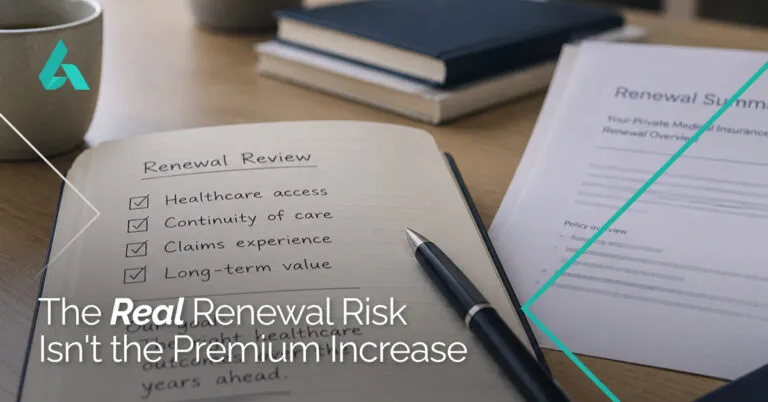
A renewal is no longer just a decision about what you’ll pay over the next twelve months. Increasingly, it’s a decision about the quality of healthcare you’ll be able to access over the years ahead. That distinction has become more significant as medical inflation, rising demand and changing policy design have reshaped the private healthcare market.
Table of Contents
Renewal Has Become a Healthcare Strategy Decision
There was a time when many renewal reviews were relatively straightforward. Policies were generally less varied in how they delivered care, private healthcare operated under less pressure and comparing premiums often provided a reasonable indication of value.
Today’s market is different.
Medical inflation has become a structural feature rather than an occasional spike. Demand for private healthcare continues to grow, while insurers increasingly use benefit architecture to balance access with long-term affordability. Outpatient pathways, diagnostic benefits and provider arrangements now influence the healthcare experience just as much as the headline description of the policy.
That means a renewal decision doesn’t simply determine next year’s premium. It helps determine how your policy will perform when you actually need it.
Why Premium Alone Can Be a Misleading Measure
Premium increases are highly visible. They’re easy to compare, easy to discuss and often feel like the clearest measure of whether a renewal has been successful.
Healthcare value is much harder to measure.
A policy that costs less may still represent excellent value if it continues to support the healthcare journey you expect. Equally, a lower premium may reflect changes that are difficult to appreciate while you’re healthy but become much more significant during diagnosis or treatment.
Perhaps outpatient investigations are more restricted. Perhaps the provider network is narrower than before. Perhaps higher excesses or different claims pathways shift more responsibility towards the policyholder.
None of these changes automatically make a policy unsuitable. The important point is that they are healthcare decisions as much as financial ones.
What a Poor Renewal Can Cost Later
The consequences of a renewal decision often emerge gradually.
A small structural change made to reduce this year’s premium may have very little effect for someone who never makes a claim. For another person, it may influence how quickly they reach a diagnosis, how much they contribute towards treatment or whether they can continue seeing the same specialist throughout their care.
For employers, the implications extend beyond the insurance policy itself.
Healthcare benefits increasingly support workforce resilience. Delays in diagnosis or treatment can affect absence, productivity and employee confidence in the benefit, even if the premium saving looked attractive when the renewal was agreed.
This is why the quality of a renewal decision cannot be judged solely by the price negotiated today. Its real value is often revealed much later, when the policy is called upon to deliver the healthcare experience it was chosen to provide.
Why Renewal Conversations Often Miss the Bigger Picture
Most renewal discussions begin with the same objective: reduce the increase as much as possible.
There’s nothing unreasonable about that. Healthcare costs have risen steadily, and ensuring a policy remains affordable is an important part of good advice.
The problem arises when affordability becomes the objective rather than one of several considerations.
It’s surprisingly easy for a renewal to become an exercise in negotiating discounts or obtaining alternative quotations before asking a more fundamental question: does the current policy still support the healthcare needs of the people it protects?
That question often receives less attention because it is harder to answer.
It requires understanding how the policy has performed, whether circumstances have changed and how today’s healthcare environment differs from the one in which the cover was originally arranged. Comparing premiums is straightforward. Evaluating long-term healthcare resilience requires judgement.
A More Disciplined Way to Review Private Medical Insurance
A stronger renewal process begins somewhere else.
Before looking at premiums, it helps to revisit the healthcare objectives the policy was intended to support.
Has your family changed? Has your business grown? Have employees’ expectations of healthcare evolved? If you’ve made a claim, did the policy perform as expected? If you haven’t, would it still support the treatment journey you would expect today?
Only after those questions have been considered does it become possible to judge whether the renewal represents good value.
Sometimes the right decision is to accept a higher premium because the policy continues to provide the healthcare access and continuity of care that matter most.
Sometimes restructuring benefits improves both affordability and long-term suitability.
Sometimes moving to a different insurer is entirely justified.
The quality of the decision comes from understanding the trade-offs before making them.
The Advisory Perspective
This is why we view renewals as healthcare planning conversations rather than annual purchasing exercises.
Price always matters. It should.
But it sits within a broader review of claims experience, healthcare access, benefit design and the resilience of the policy over time. That wider perspective often changes the conversation.
Instead of asking, “How much can we reduce the premium?”, clients begin asking whether the policy still reflects the healthcare strategy they want for themselves, their family or their workforce.
The answer may be to keep the existing arrangement, to redesign it or to move elsewhere.
What’s important is that the decision is driven by healthcare outcomes rather than by price alone.
Key Takeaway
A successful renewal is not necessarily the one with the lowest premium. It’s the one that leaves you confident your policy will continue to deliver the healthcare experience you expect when you need it most. Premium increases deserve careful scrutiny, particularly in a market shaped by persistent medical inflation.
But the more important question is whether your renewal strengthens or weakens your long-term healthcare strategy.
When renewal conversations move beyond annual pricing and become discussions about healthcare access, continuity of care and long-term resilience, they tend to produce better decisions, and ultimately, better outcomes.