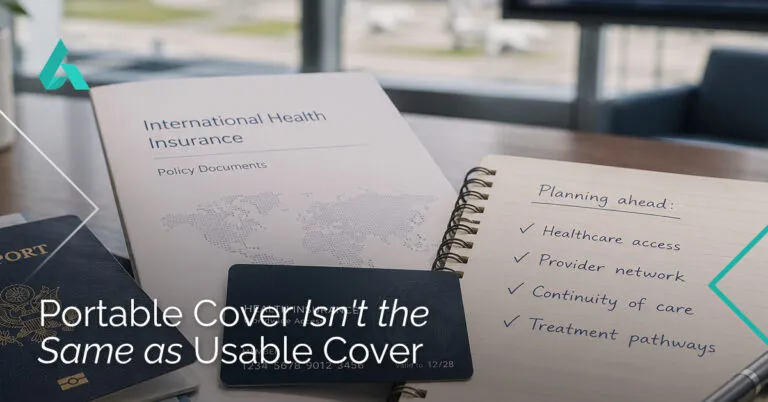
Most people only discover what their international or private medical insurance really provides when they need treatment somewhere other than home.
Until then, portability often feels like a reassuring concept. If a policy says it offers worldwide cover, or confirms that treatment is available overseas, it is natural to assume that accessing healthcare abroad will be much the same as it would be at home.
That assumption deserves closer examination.
Healthcare has become more interconnected, but also more operationally complex. Provider networks differ between countries. Referral pathways vary. Authorisation requirements are becoming more sophisticated. Even where two policies provide identical geographic cover, the practical experience of arranging treatment can be very different.
The question is no longer simply whether your insurance travels with you. It is whether the healthcare experience you expect can realistically travel with it.
Table of Contents
What “Portable” Actually Means
When insurers describe a policy as portable, they are usually answering a contractual question.
Can the policy provide cover if treatment is required in another country?That is an important question, but it is only one part of the picture.
A policy’s geographical area of cover explains where claims may be considered. It says far less about how treatment will actually be arranged once a claim begins. Which hospitals are available? Is direct settlement possible? Does treatment require pre-authorisation? How easily can specialists be accessed? Will existing care continue without interruption?
In practice, those operational questions often shape the healthcare experience far more than the geographical wording itself.
This distinction matters because healthcare is delivered through systems, not insurance certificates. Insurance may fund treatment, but it still depends on hospitals, clinicians, referral processes and local healthcare infrastructure working together effectively.
Why Healthcare Access Changes Across Borders
Healthcare is not organised in the same way everywhere.
Some countries have extensive private hospital networks with established relationships between insurers and providers. Others rely more heavily on reimbursement, requiring patients to pay first before recovering costs. Referral systems can differ significantly. Access to specialist consultants may vary by region, and certain treatments may only be available through specific centres.
Insurers increasingly differentiate themselves through operational capability rather than headline benefits. Provider relationships, clinical support teams, case management and local expertise all influence how smoothly treatment progresses.
It reflects a broader shift across healthcare. As medical costs continue to rise and international healthcare becomes more specialised, insurers are investing more heavily in managed care arrangements, provider partnerships and treatment pathways rather than simply expanding lists of insured benefits.
For policyholders, this means that two policies offering worldwide cover may deliver noticeably different experiences when a claim actually occurs.
Where Clients Discover the Difference
In practice, portability is rarely tested during routine travel.It tends to matter when life becomes more complicated.
Perhaps a family relocates overseas and one member requires ongoing specialist treatment shortly afterwards. A business traveller develops a condition that needs investigations beyond emergency care. An employee working internationally needs continuity between treatment started in one country and follow-up care in another.
At that point, the question extends well beyond whether a claim is technically covered.
The practical questions soon emerge. Which specialists are available? Can existing consultants continue treatment? Will the insurer arrange appointments directly? Does authorisation transfer smoothly between countries? Is there an established provider network nearby, or will reimbursement be the primary route?
None of these issues necessarily indicate poor insurance. They illustrate that healthcare delivery is influenced by far more than the policy wording.
Why Many Policy Reviews Miss This
Renewal conversations often begin by confirming that worldwide cover remains in place.
Once that box has been ticked, attention naturally moves towards premium, excesses or benefit changes.
Yet portability is often treated as a feature instead of being examined as a real healthcare experience.
Clients may never discuss where they realistically expect to receive treatment over the coming years. Businesses may not consider how internationally mobile employees would actually access healthcare if they relocated or travelled extensively. Families may assume continuity of treatment would happen automatically because the policy remains valid.
These assumptions often remain unchallenged because they have never previously been tested.
A policy that performed well several years ago may still be the right choice today. Equally, changes in healthcare delivery, provider availability or personal circumstances may justify a much closer review than simply confirming the geographical area of cover remains the same.
A Better Way to Evaluate International Healthcare Cover
A more useful question is not simply where a policy provides cover, but how healthcare would actually be delivered.
If treatment became necessary, which hospitals would most likely be involved? How would referrals be arranged?
If ongoing care crossed international borders, how easily could treatment continue?Would the insurer organise care directly, or would reimbursement be the expected route?
For employers, similar questions apply at an organisational level. International healthcare benefits often aim to support workforce resilience, attract talent and give employees confidence when working abroad. Those objectives depend as much on reliable access and operational delivery as they do on the contractual scope of cover itself.
Looking beyond benefit schedules to the healthcare experience itself usually gives a far more realistic indication of how a policy will perform when it matters most.
What Good Advice Should Help You Understand
The best conversations rarely begin with product comparisons.They begin by understanding how healthcare is likely to be used.
That includes where someone lives today, where they expect to travel, whether family members may relocate, what ongoing healthcare needs already exist and how treatment might realistically unfold if a diagnosis occurred tomorrow rather than several years from now.
The discussion can then move naturally to provider access, operational differences between insurers, continuity of care and the practical trade-offs involved in different policy designs.
Not every client requires the same solution. Someone who travels occasionally on short business trips faces different considerations from a family relocating internationally or an employer supporting a globally mobile workforce.
The objective is not to find the broadest geographical wording available. It is to understand whether the policy can reliably support the healthcare journey the individual or organisation is most likely to experience.
Portable Cover Answers One Question. Usable Cover Answers Another.
Portable cover asks whether your insurance can operate where treatment is needed.
Usable cover asks whether it can reliably deliver the healthcare experience you expect once treatment begins.
Those questions often overlap, but they are not identical.
As healthcare becomes more heavily shaped by provider networks, treatment pathways and operational delivery, understanding that distinction is becoming more important. A policy’s value is measured not only by where it applies, but by how effectively it helps you obtain appropriate care when circumstances become more complex.
That is why the most valuable review often moves beyond geography and benefit schedules. It considers something far more practical:
Not whether your cover can travel with you, but whether your healthcare can.