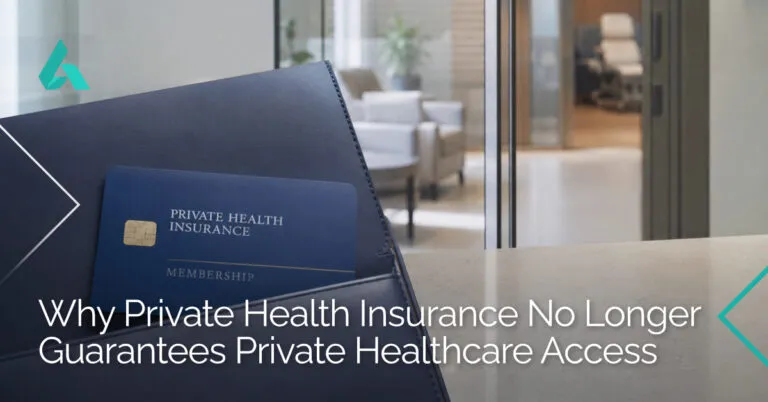
For many people, arranging private medical insurance feels like crossing an important item off life’s checklist. Once the policy is in place, it’s natural to assume that if a health problem arises, access to private healthcare will follow.
For a long time, that assumption was broadly reasonable. While policies certainly differed, those differences often had less influence on the overall healthcare experience than they do today. The key decision was whether you had cover at all.
Healthcare has changed.
Owning private medical insurance remains enormously valuable, but it no longer tells us as much about the healthcare journey someone is likely to experience. As demand for private treatment has grown and insurers have adapted how policies are designed, the quality of healthcare access has become a more meaningful question than policy ownership alone.
Table of Contents
Healthcare Has Changed More Than Most People Realise
The healthcare landscape now looks very different from the one many people had in mind when they first arranged their cover.
Pressure on NHS services has encouraged more patients to seek private diagnosis and treatment. At the same time, employers are investing more heavily in healthcare benefits, and increasing numbers of people are choosing to self-fund treatment rather than wait. Together, these changes have increased demand across the private healthcare sector.
Insurers have responded by evolving policy design rather than simply increasing premiums year after year. Modern policies often differ in outpatient benefits, referral pathways, provider access and the way treatment is authorised. Those differences are intended to balance healthcare access with rising medical costs, but they also mean that policies which appear similar on paper can operate quite differently in practice.
Insurance has become less of a binary question, insured or uninsured, and more a question of how effectively a policy supports the healthcare journey someone expects.
Why Two Similar Policies Can Produce Very Different Healthcare Journeys
Imagine two people who both describe their cover as “comprehensive”.
Each develops the same medical condition. Each expects a prompt diagnosis, access to an appropriate specialist and treatment without unnecessary delay.
Their experiences may not be identical.
One policy may offer broader outpatient investigations before treatment begins. Another may require different authorisation processes or provide access through a more defined network of hospitals and consultants. Neither policy has necessarily failed. They have simply been designed differently.
This distinction is easy to overlook because marketing descriptions tend to focus on what a policy includes rather than how care is likely to be delivered when it is actually needed.
Increasingly, the healthcare journey depends on operational details that rarely receive much attention when a policy is first arranged.
The Hidden Cost of Thinking Only About Premiums
Renewal discussions often begin with a perfectly reasonable question:
“How much has the premium changed?”
Cost matters. Medical inflation has become a long-term feature of the market, and every household or business has a budget to consider.
The difficulty arises when premium becomes the only measure of value.
Reducing costs can be entirely appropriate if the trade-offs are understood. Problems emerge when decisions gradually alter the quality of healthcare access without anyone recognising the implications until years later.
A policy may continue to provide broad cover while offering a different healthcare experience from the one originally expected. By the time those differences become apparent, changing direction may be more complicated than it would have been earlier.
Where People Often Get It Wrong
Most clients don’t make poor decisions because they ignore their health insurance. They make them because they rely on assumptions that once worked well.
If a policy is described as comprehensive and has performed well previously, it feels reasonable to expect it will continue doing so. Many conversations reinforce this thinking by concentrating on premiums, excesses and headline benefits, because these are easy to compare.
Healthcare access is much harder to summarise.
It depends on how diagnosis, specialist access, treatment pathways and continuity of care work together when someone becomes unwell. Those are rarely the first topics discussed during a purchase or renewal, despite often having the greatest influence on the overall experience.
Better Questions Lead to Better Decisions
As healthcare has become more complex, the questions worth asking have changed too.
Rather than asking only whether a policy is competitive on price, it may be more valuable to ask:
- What healthcare experience am I actually trying to protect?
- If I needed specialist investigations tomorrow, would this policy support the journey I expect?
- How important is continuity with the same consultant throughout treatment?
- What trade-offs am I making if I reduce premium?
- Will this arrangement still meet my needs if healthcare demand continues to increase?
These questions don’t always lead to more expensive policies. They lead to better-informed decisions.
The Advisory Perspective
This is why our conversations increasingly begin with healthcare rather than insurance.
Before discussing insurers or policy features, we try to understand the healthcare journey someone wants to preserve. Only then does it become possible to judge whether a policy’s design genuinely supports those expectations.
Sometimes the review confirms that an existing arrangement remains an excellent fit. Sometimes it reveals that healthcare has changed more quickly than the assumptions behind the policy.
Either outcome is valuable because the objective is not to own private medical insurance. It is to maintain reliable access to healthcare over many years.
Key Takeaway
Private medical insurance remains one of the most effective ways to improve access to healthcare.
What has changed is the assumption that owning a policy automatically guarantees the healthcare experience people expect.
Today, the quality of healthcare access increasingly depends on how a policy has been designed, how care is delivered in practice and whether those arrangements continue to support your needs as healthcare evolves.
The most valuable question is no longer whether you have private medical insurance.
It is whether your policy will deliver the healthcare journey you believe it will.